
 Jackpots
 VIP Club
 Promotions

What Is a 3 Bet in Poker and How Does It Work?
Ever wonder what does 3-bet mean in poker? In fact, it’s a part of a basic counting game. The starter bets count as number one, which means the first actual raise is number two. Whether you have just begun learning the basics or have years of experience, mastering 3-bet in poker can instantly change the game. Moreover, understanding when to use it allows you to take full control of the table. Ready to dive into all the details and the strategies? Then follow our guide and start playing poker at a completely new level.
What Is a 3-Bet in Poker?
Undoubtedly, the first detail we should explain is what is a 3-bet in poker. In truth, it could be a bit confusing since it sounds like you are placing three separate bets. But in reality, you need to count in a different way.
The first bet is called the blind. It’s the case when two players must put chips into the pot before anyone even looks at their cards.
The second bet is the open raise. Now, everyone sees their own cards. It is the moment when one player decides to increase the stakes.
Finally, once the previous steps are complete, there is a moment for the re-raise, or a 3-bet, in poker. It is called that way because the player who decides to raise again over the previous raise puts in the third bet. And, as you can note, such a move is aggressive. It forces other players to decide whether to fold, match the stakes, or even 4-bet. In fact, we will discover this moment in detail a bit later. But is the difference between a raise and a re-raise? Let’s find out below.
In addition to understanding all the game’s details and what does 3-bet mean in poker, it is also important to find a trusted online casino. Here, on Spinarium, you can get both security and a positive experience. Explore the platform today and earn the rewards we already prepared for you!
Why Is It Called a 3-Bet?
To avoid any misunderstandings, it could be better to find the exact difference between a raise and a re-raise. As we already noted, a raise always goes after the blinds. In other words, you are betting against the first bet, raising the initial stake. For example, the blinds are $2, and your raise is $5.
In contrast, a re-raise, or a 3-bet in poker, challenges not the initial bet, but the previous raiser. You simply increase the price after someone has already raised it. For example, while the raise was $5, your bet is already $10.
In the end, the blinds are the first bet, and the initial raise is the second bet. It chronologically makes the re-raise as the third wager, or a 3-bet, put into the pots.
How Does a 3-Bet Work in Poker?
As we already mentioned, a 3-bet in poker is an aggressive move. It allows you to take control of a hand right from the start. Of course, if you are looking at what is 3-betting in poker, understanding the details is important . No less important is where you sit at the table and how the other players react to your re-raise. And the best way to explore everything is with the right examples below.
Some users can learn everything faster through practice rather than exploring guides and tons of details. One of them? Then be sure to try our online poker games. Discover top titles on the platform and begin your journey right now!
Preflop 3-Betting Explained
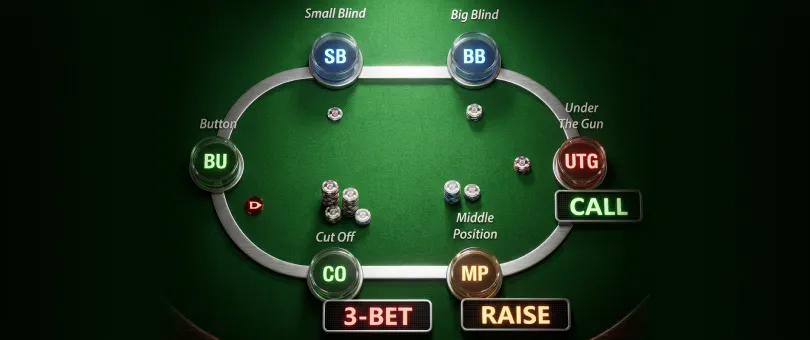
So, what is the most common use of a 3-bet? In short, preflop 3-betting takes place when players hold two starting cards. In other words, before the community cards hit the table. It’s the most common use of a 3-bet in poker. The only goal of a 3-bet is to build a strong hand (e.g., Pocket Aces) or bluff to force opponents to fold.
Still, your position at the table changes everything. There are two possible cases, and your move depends entirely on which one occurs. For example, you could be in position (acting last). In that case, a 3-bet in poker adds pressure on the original raiser. Now, they have only the option of playing the rest of the hand with less information.
In contrast, 3-betting out of position (acting first) is much riskier. Moreover, your cards should be significantly stronger to justify the move. In the end, a preflop 3-bet simply filters out the weak hands.
Example Hand Showing a 3-Bet
Still, for players looking at what is 3-betting in poker, it might be better to see an actual example. First, let’s imagine a game with the blinds as $1 and $2. The player with a good hand decides to make an open raise to $6. The 2-bet. Now it’s someone else’s turn, who either has a strong hand or can get others to think he does. They re-raise to $18. This is already the 3-bet in poker.
As you can see, the most noticeable detail in the topic of what is a 3-bet is how quickly the pot grew to much higher stakes. And, undoubtedly, such an aggressive move forces everyone to play for these stakes very quickly.
What Happens After a 3-Bet?
No less important detail in the topic of what is a 3-bet in poker is understanding the possible scenarios after such a move. Fortunately, there are only three of them. Still, it could be helpful to explore each of them separately.
The first possible scenario is folding. In fact, it is the most common response to a 3-bet in poker. In that case, you just take the initial investment from the players who aren’t ready to match your bet or re-raise it further.
The second case is calling. Now, the player matches the re-raise amount. In other words, they have a nice hand, but don’t want to play with an inflated pot at the moment. In that case, the chips go into the middle, the hand transitions to the Flop, and the dealer lays down the first three community cards face-up. Overall, a new round of betting begins.
The last possible scenario is 4-betting. While a 3-bet is an aggressive move, 4-betting is even more aggressive. Still, it also could be a sign of either a strong hand or a bluff. In the end, it is now your turn to decide whether to fold, call, or re-raise the stakes.
Why Players Use 3-Bets
One more detail you might wonder about if you are looking for what is a 3-bet in poker, is why players use it. Well, in truth, it’s not just an aggressive move, but a calculated strategy. And, of course, it has three goals.
First, players who are searching for what is a 3-bet, know that this move helps you build a bigger pot. In fact, premium holdings let you play high-stakes games with minimal risk. In the end, it helps you maximize your profit right away by forcing your opponents to pay extra to see the next cards.
Also, as we previously mentioned in our “What is 3-betting in poker” guide, a 3-bet applies pressure to opponents. This move forces folds and takes control of the hand without even seeing the community cards.
In the end, a 3-bet in poker also isolates weaker players. As you can note, playing against numerous opponents is totally unpredictable. With such a move, you instantly reduce the number of active opponents. Overall, the strategy’s three goals transform your re-raise into a dominant tactic.
Looking for the right poker simulator to try one or more new strategies? With Spinarium, you always have access to free poker games. No deposit, no downloads, just pure experience without spending money!
Value 3-Bets vs Bluff 3-Bets
No less important in the topic of what is a 3-bet is the difference between a value 3-bet and a bluff 3-bet. In fact, every time you make such an aggressive move, you need a reason. It’s not about throwing chips randomly; it’s the detail that instantly separates newcomers from experienced players. How much do you bet? Who is your target? How will you react if your opponent fights back? Let’s check both sides of the coin below.
Video poker games could be an exciting test of strategy and skill. Play your cards right and get the reward on Spinarium right now!
What Is a Value 3-Bet?
A value 3-bet simply means you have a strong hand and are ready to win a bigger pot. With premium holdings like Pocket Aces, Pocket Kings, or Ace-King, you completely expect your opponent to match the raise with a worse hand. In that case, you don’t want to scare other players, but you do want to get as many chips as possible.
What Is a Bluff 3-Bet?
On the other hand, a bluff 3-bet is a way to win with weaker cards. Here, the win odds rely on fold equity. In other words, the mathematical probability that your opponent will simply fold and give up the pot.
Still, it’s better to note that even experienced players rarely use pure bluffs. They prefer semi-bluffs. It means the hands aren’t perfect at the moment, but have a chance to improve later (e.g., the 8 and 9 of hearts or Ace-low suited cards).
By using a bluff 3-bet, you give yourself two options to win. While the first one is guaranteed since the opponent might fold instantly, the second relies on luck. In other words, if they do call, you have a chance to hit a straight or a flush in the later rounds.
What Is a Good 3-Bet Size?
While we already explored almost everything, there is still an important question we shouldn’t ignore: what is a good 3-bet size in poker? Well, the math is simple here. With a tiny bet, you invite opponents to call, while with a too-big one, you force them to fold.
In fact, if you are looking for what is a good 3-bet size in poker, it could help to know that sizing depends on whether you are in position or out of position. In the first case, when you act last, it is better to aim for 3x the original raise (e.g., your bet is $18 vs $6 as the original bet). For the second case, when you act first, make a 4x raise (e.g., your bet is $24 vs $6 as the original bet).
Ready to test your knowledge? Then explore the variety of online table games on Spinarium and discover a world of classic casino favorites.
3-Betting Strategy for Beginners
Now, you know what a 3-bet in poker is. But what is the strategy for beginners? Well, the most important detail is to keep it simple. Look to a 3-bet in poker when you want to build a massive pot with high-tier cards. Or, for example, when you want to isolate a predictable opponent to play one-on-one.
Also, it could help, at the beginning, to use a 3-bet only with high-tier cards in poker. Pockets Aces, Kings, Queens, and Ace-King are your best options. Such hands are the easiest to play after the flop.
Still, you are better off avoiding 3-betting against players who rarely raise. It could be a sign of having a strong hand, especially if they put chips in. No less important to mention are medium-strength cards (e.g., Pocket Jacks or Ace-Ten). It could be better to avoid a 3-bet when you have to act first with such a hand.
Frequently Asked Questions About 3-Bets in Poker
It simply means a re-raise on an initial raise before the community cards are dealt. It comes after the first and the second bets. Such a move forces other players to fold, match the price, or answer with a bigger raise.
In fact, it represents a premium holding. In practice, depending on the strategy and the player’s experience, it could be either a strong hand (e.g., Aces or Kings) or a bluff (e.g., unpaired high cards).
A standard raise, also known as a 2-bet, is a moment when a player increases the stakes against the forced blinds. In contrast, a 3-bet is a specific type of re-raise. It directly challenges such a player who has just raised. In the end, it turns the stakes up even higher.
In a 6-player online game, it ranges between 7% and 10%. The low percentage could be a sign that opponents have a premium holding. It instantly leads to folds. In contrast, the high percentage could be a sign of holding too many weak hands.
Yes, it’s a nice strategy, which forces your opponents to fold medium-strength cards. Still, it’s better not to use completely random cards for a 3-bet, but rather semi-bluffs. For example, 7-8 or Ace-4. In the end, using it can force an instant fold or build a strong hand.
As soon as it happens, the original raiser faces a decision. They can fold (fold cards and give up the chips they put in), call (match the new price to see the cards), or 4-bet (re-raise again).