 Jackpots
 VIP Club
 Promotions

Understanding the Worst Hand in Poker: Why 7-2 Offsuit Is So Weak
In Texas Hold’em, every round starts with two cards, and those two cards shape your whole decision. Some hands offer strong chances from the start, while others leave you with very few options. That is why players pay close attention to the worst starting hands in poker, because the choice you make at the beginning can influence everything that follows.
But not all hands deserve the same respect. Many players ask what is the worst hand in poker, and one specific combination comes up again and again: 7-2 offsuit. At first glance, it may not look that bad, yet it carries hidden problems that become clear as the hand plays out. In this guide, you will see why this hand struggles so much and how to deal with it effectively.
What Is the Worst Hand in Poker?
If you still ask what is the worst hand in poker, keep the answer simple: 7-2 offsuit. This hand earns that title in Texas Hold’em because the seven is a poor high card, the deuce adds very little, and the offsuit setup cuts out flush value right away. When players debate what is the worst hand in poker, this hand stays at the center of the talk.
Many hands in poker look weak at first, but they still hold one useful trait. A hand like 6-5 suited can flop a draw. A hand like A-2 offsuit can still pair an ace. Small pairs can hit a set. The worst poker hand offers little of that.
That is why players use seven-deuce as the first example when they talk about the worst hands in poker. Other starts may have one path that can save them. This one lacks almost all of those paths.
Why 7-2 Offsuit Is the Worst Hand in Poker
7-2 offsuit ranks as the worst hand in poker because it offers very little value from the start and very few ways to improve. Below are the key reasons that explain its weakness:
No Straight Potential
A lot of bad cards are still close enough to build straight draws. Cards like 8-7 or 6-5 can hit open-ended draws, gutshots, or pair-plus-draw boards that leave room for pressure on later streets. Seven-deuce does not give you much. The gap is wide, and the ranks are low, so the road to a straight looks narrow from the start. This weak straight value plays a big role in the case for the worst hand in poker. In many hands of poker, the gap between your cards tells you a lot about future value.
No Flush Potential
The hand comes offsuit, so neither card shares a suit. That means you lose a whole category of upside before the flop even lands. Suited trash can still hit a flush draw and force hard choices on later streets. Seven-deuce offsuit cannot do that.
This point matters because many of the worst hands in poker still carry some suit value. Once you lose that extra route, your hand has to rely on pairs and rare board help. The worst poker hand does not have much left after that.
Weak High Card Value
The seven acts as the high card, and that creates another problem. If you pair the seven, you will often face a better seven with a better kicker, or a higher pair from another player. If you pair the deuce, your hand looks even weaker.
That poor high-card power explains a lot about what is the worst hand in poker. A hand like K-2 offsuit still has flaws, but a king can pair into top pair on some boards. Seven-deuce does not have that safety net. In plain terms, the worst hand in poker gives you weak pair value even on the flops that seem to help you.
Poor Equity Against Other Hands
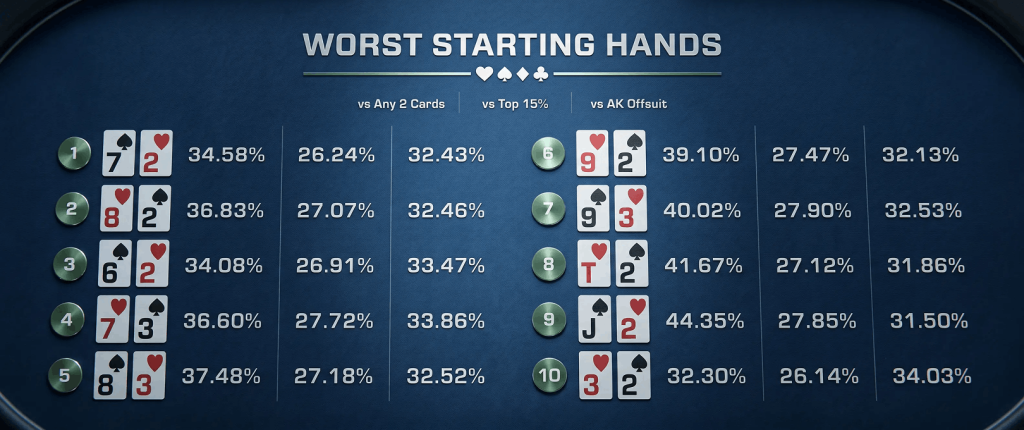
Preflop equity tells you how often one hand can win if all five board cards run out. Seven-deuce offsuit does poorly here, too. Strategy sources place 7-2 offsuit at about 34% to 35% heads-up against a random hand, while pocket aces is near 85% in the same kind of test. That gap explains the whole story in one snapshot. The worst poker hand starts far behind, while the best hands start far ahead.
That edge gets worse against a normal raising range. In real games, an open raise often means Broadway cards, pairs, or strong aces, not random junk. Against that kind of range, the worst hand in poker falls into an even deeper hole. So if you want one easy rule, fold seven-deuce in almost every normal spot.
Worst Starting Hands in Poker (Beyond 7-2 Offsuit)
Seven-deuce gets the crown, but other weak starts belong in the same rough tier. These worst hands in poker often share the same features: low ranks, bad connection, weak top-pair value, and very little post-flop help. They may shift a little in some models, yet they still cost chips when you overplay them. You can try these hands yourself through free online Poker games and see how often they struggle. Below you can see the worst starting hands in Poker:
8-2 Offsuit
8-2 offsuit performs a bit better than 7-2 offsuit. Against one random hand, it wins around 36% to 37% of the time, which means a gain of about 2 percentage points. That small increase does not change much in real play. The hand still has no suited value, and the gap between the cards limits straight chances. When you hit a pair with the 8, a better kicker often beats you. In multiway pots, the win rate can drop below 6%, which shows how fast this hand loses strength.
9-2 Offsuit
9-2 offsuit is slightly better and wins about 37% to 39% against a random hand. That puts it ahead of 7-2 offsuit in raw equity, but not by much. You still have an offsuit hand with poor connection and weak post-flop value. If you pair the 9, you can still face 10-x, J-x, Q-x, or, better yet, 9-x hands that leave you second-best. Even with a higher number, players still group this hand with the worst hands in poker because it performs poorly in most real situations.
10-2 Offsuit
10-2 offsuit moves slightly higher, with about 38% to 40% equity against one random hand. The 10 can connect with more boards, but the deuce creates a very weak kicker. This leads to costly mistakes when you think you have a decent hand but face a stronger one. The lack of suited value and poor straight potential still limit this hand. Even if the percentage looks better, the hand is still weak against playable hands.
3-7 Offsuit
3-7 offsuit stays close to 7-2 offsuit in strength. It wins about 35% to 37% of the time against a random hand, so the difference remains minimal. Both cards are low, which means weak pair value, and the offsuit structure removes flush chances. Straight potential also stays limited due to the gap between ranks. If you look at 7-2 offsuit, the difference is minor, so both hands call for the same choice: fold and wait for a better opportunity.
If you want to explore more variations of hands in poker, you can check online Poker games and practice different scenarios.
When (If Ever) Should You Play the Worst Hand in Poker?
In most situations, you should fold 7-2 offsuit and wait for a stronger hand. Still, a few rare spots can open the door for action with the worst hands in poker. From a late position, such as the button, you may try a bluff if all players fold and the blinds often give up. In those cases, the success of your move depends more on position and player behavior than the cards you hold.
Table dynamics play a big role, too. When you face tight players, you get more chances to steal small pots, but loose players who call often remove most of this hand’s value, which is common for the worst hands in poker.
The game format also affects your decision. In tournaments, especially with around 10 to 15 big blinds, you may need to play more aggressively, even with weak hands, because blinds keep rising. In cash games, you usually have more flexibility, so folding remains the best choice in most cases.
There is also a psychological side. A rare move with a weak hand can make your play less predictable, but this should happen very rarely and only with a clear reason. With time, strong discipline and patience will work better than pushing the worst hand in Poker.
If you want to explore other games and formats, you can visit free casino games and gain more experience.
Strategy Tips: What to Do When You Get 7-2 Offsuit
Usually, the best move is to fold 7-2 offsuit and go to the next hand. This hand is at the bottom, so you do not gain much by entering the pot. If you keep it, you will often face stronger pairs or better draws, and that can cost you chips fast. So instead of forcing action, wait for a hand that gives you a clearer path. Poker rewards players who wait, and folding here keeps your balance safer.
At the same time, manage your emotions and make smart decisions. Do not chase the idea of winning with a weak hand just to prove a point. You can still use 7-2 offsuit in rare bluff spots, but only when position and table behavior support your move. Even then, you need a clear reason, not a guess.
Discipline plays a key role here, as strong players know when to step back and wait for better opportunities. You can learn more advanced approaches through online Poker strategy.
Worst Hand in Poker vs Best Starting Hands
The contrast here looks huge. Pocket aces start as the best hands in Texas Hold’em poker, and they win about 85% of the time heads-up against a random hand. Seven-deuce offsuit sits near 34% to 35% in the same test. So the worst hand in poker does not trail by a little. It trails by a huge margin.
The best hands also play better after the flop. A-A can flop a set or hold as an overpair. A-K can hit top pair with a strong kicker, and suited A-K can also chase the nut flush. The worst poker hand does almost none of that well.
That contrast helps answer what is the worst hand in poker in the most practical way. The hand lacks both raw equity and future value. Many hands in poker need care, but seven-deuce asks for the most caution of all. You can also try different formats through free casino table games to see how hand strength changes.
Final Thoughts on the Worst Hand in Poker
So, what is the worst hand in poker? Hands in Texas Hold’em poker, 7-2 offsuit earns that label in most strategy guides and player talk. The hand has low card strength, no suited value, weak straight routes, and poor equity against useful ranges. That full package explains why players keep it at the bottom of the list.
You will still see seven-deuce win now and then. Poker always leaves room for lucky boards and wild stories. But one lucky pot does not change the long-run truth. The worst hand in poker stays weak, so your best move will usually be a fast fold. If you want more tips, guides, and strategies, visit an online casino or read our blog for more content.
FAQ Section
What is the worst hand in poker?
Among hands in Texas Hold’em poker, 7-2 offsuit is known as the worst hand. Many players call it the worst since the cards are not the same suit, do not connect, and stay low in value.
Why is 7-2 the worst hand in poker?
Players call 7-2 offsuit the worst hand in poker because it cuts out flush value, weakens your straight chances, and leaves you with poor pair strength on many boards. That mix drops it below almost every playable start in normal spots.
Can 7-2 offsuit ever win?
Yes, 7-2 offsuit can win, but the hand wins far less often than premium starts. Over many deals, this stays the worst poker hand to open with in Hold’em.
What are other bad hands in poker?
Other bad starts include 8-2 offsuit, 9-2 offsuit, 10-2 offsuit, and 3-7 offsuit. These hands use low numbers, have little connection, and form weak pairs, so you should be careful when you get them.
Should you ever play the worst hand in poker?
You should fold the worst hand in poker in most spots. A late-position steal, a short-stack shove, or a side-bet game can change the choice, but those spots stay rare.